Creating a beautiful home isn’t always about spending more.
You can buy an expensive sofa, beautiful accessories, and trendy furniture and still walk into the room feeling like something is… off.
Meanwhile, another home might be filled with affordable pieces and somehow feel polished, warm, and thoughtfully designed.
The difference usually isn’t the price tag.
It’s how the room is put together.
A well-designed home feels intentional. The proportions make sense. The lighting creates atmosphere. The colors relate to one another. Furniture has room to breathe. And the things you choose to display feel like they belong there.
So if you want your home to look more elevated without spending a fortune, don’t start by buying more decor.
Start with these nine design principles instead.
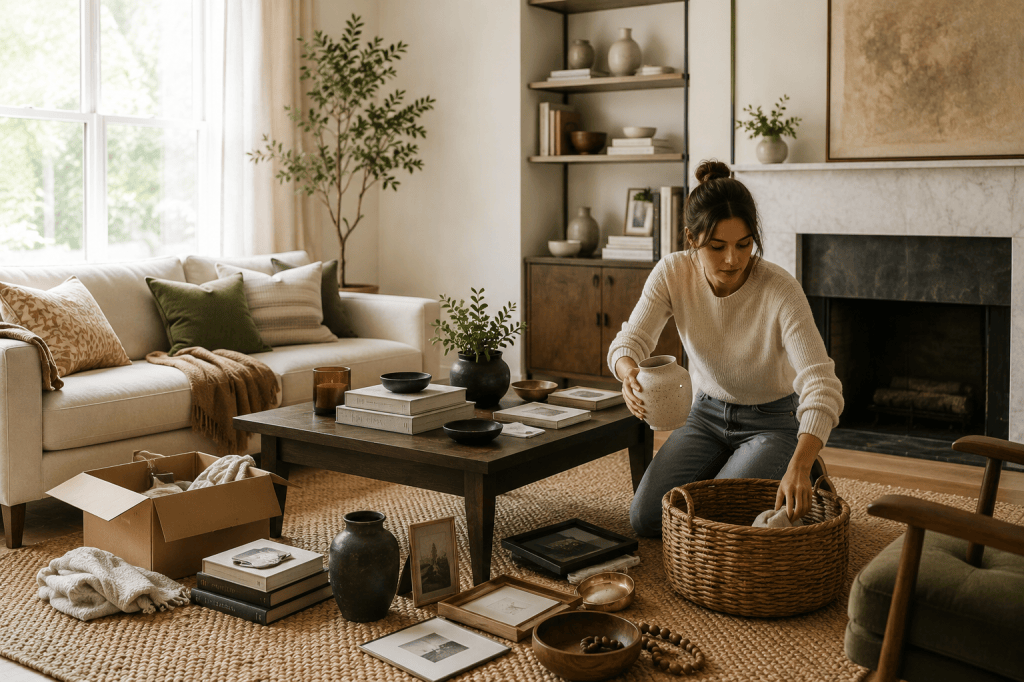
1. Edit the Room Before You Add Anything New
When a room feels unfinished, our first instinct is often to add something.
Another pillow.
Something for the empty corner.
More artwork.
A decorative object for the coffee table.
But sometimes, the room doesn’t need more. It needs less.
Before buying anything new, take a good look at what is already there.
Remove the objects that don’t contribute to the room and pay attention to things like small accessories scattered across surfaces, furniture that interrupts the natural flow of the space, visible cords, or decor that was added simply because there was an empty spot.
Then step back and look again.
You may be surprised by how much calmer and more intentional the room feels.
Empty space isn’t wasted space. It gives the pieces you actually love room to stand out.
Designer tip: Before asking, “What should I add here?” ask, “Is there anything I should remove first?”
2. Get the Scale and Proportion Right
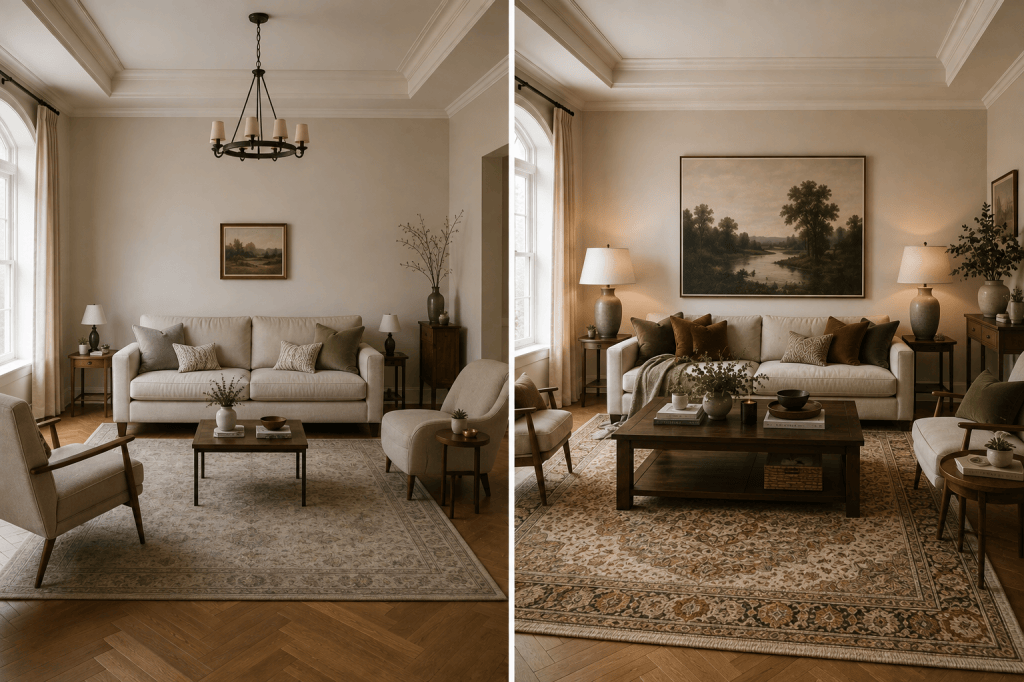
You don’t necessarily need expensive furniture to create a beautiful room.
But you do need furniture that feels appropriately sized for the space—and for the other pieces around it.
Scale is one of those things you might not consciously notice when it’s right, but you can often feel when it’s wrong.
Think about a tiny rug floating in the middle of a large living room.
Or a small piece of artwork hanging alone on a huge wall.
Or a tiny coffee table sitting in front of an oversized sectional.
Each piece might look perfectly nice on its own, but together the room can feel disconnected.
Instead of choosing every item individually, think about how the pieces relate to one another.
In a living room, for example, the rug should help visually connect the seating area rather than look like a separate island underneath the coffee table.
Artwork should also relate to the furniture or wall beneath it. Sometimes one larger piece creates a much stronger impact than several small pieces scattered across a large wall.
The goal isn’t simply to choose bigger things.
It’s to create proportion.
3. Hang Your Curtains Higher and Wider
Curtains can completely change the proportions of a room.
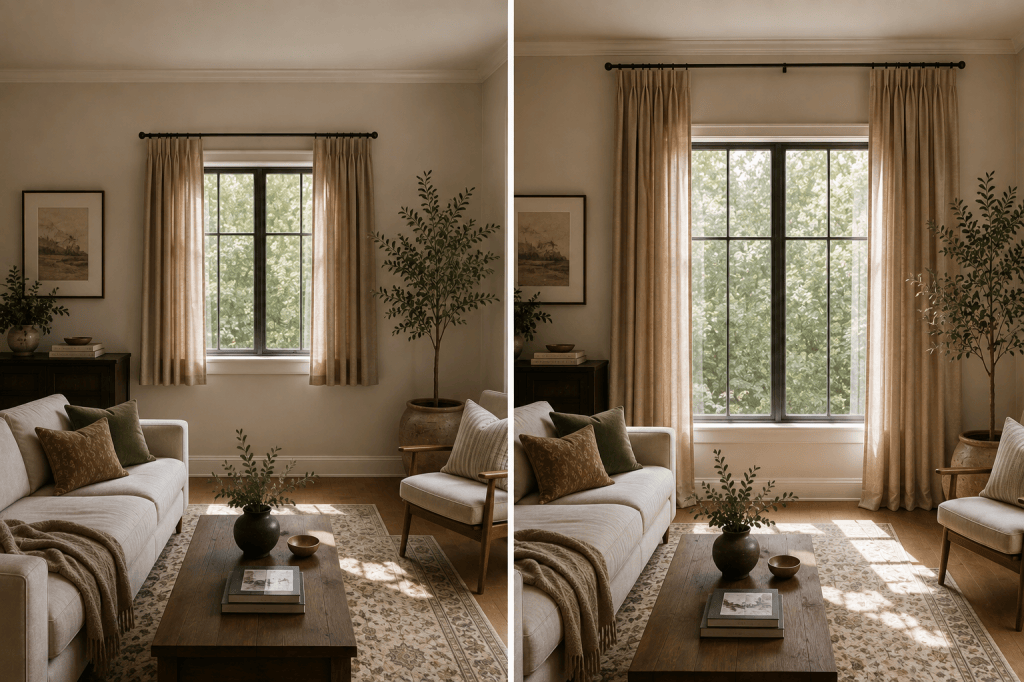
One of the most common mistakes is installing the curtain rod directly above the window and ending it close to the edges of the window frame.
This visually emphasizes the size of the window itself.
Instead, when your space allows it, position the curtain rod higher and wider than the window.
Extending the rod beyond the window lets the curtain panels sit partially beside the glass when they’re open, allowing more natural light into the room and making the window appear more substantial.
Length matters too.
Curtains that stop awkwardly above the floor can make a room feel unfinished. In most spaces, panels that reach the floor create a cleaner and more intentional visual line.
And you don’t necessarily need custom curtains to achieve this.
Affordable curtain panels can look beautiful when:
- they’re long enough,
- there’s enough fabric to create fullness,
- the hardware is simple and well placed,
- and they’re installed at the right height.
This is a perfect example of placement making a bigger difference than price.
4. Layer Your Lighting
Lighting can completely change how you experience a room.
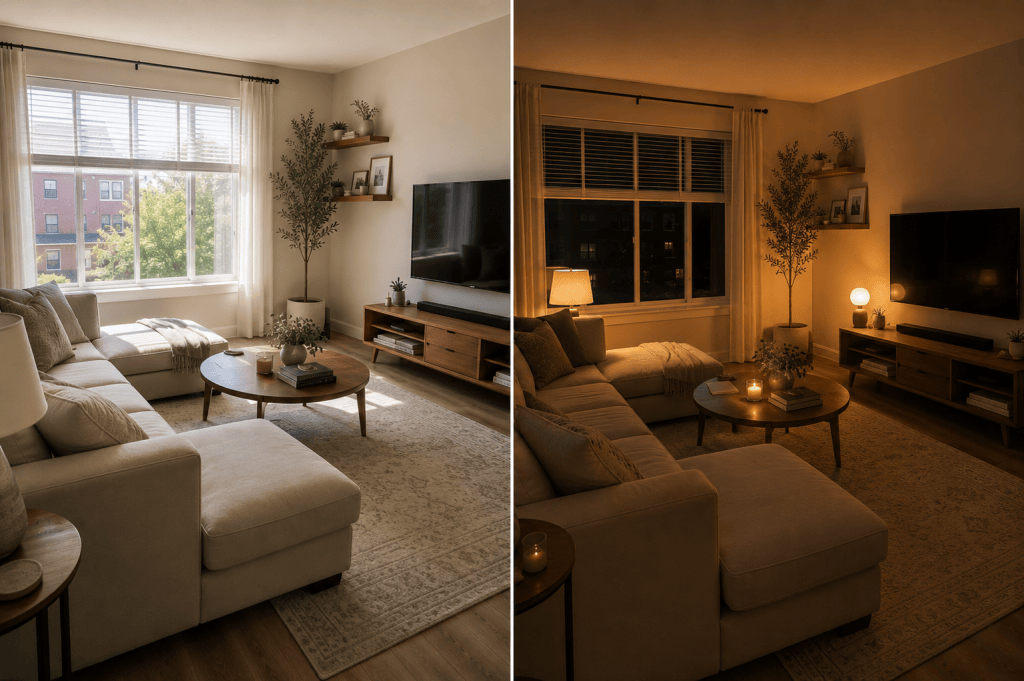
A space that looks beautiful during the day can suddenly feel flat or harsh at night if the only source of light is one bright ceiling fixture.
Instead of relying on a single light source, think about lighting in layers.
There are generally three useful types of lighting:
Ambient lighting provides the overall illumination in a room.
Task lighting helps with specific activities such as reading, cooking, or working.
Accent lighting adds atmosphere or draws attention to particular areas or objects.
You don’t need every type of lighting in every corner.
The important part is having light coming from different heights and locations.
For example, a living room might have a ceiling fixture for general light, a floor lamp beside a reading chair, and a small table lamp creating a warm glow in another corner.
Try this tonight: turn off your main ceiling light and use two or three smaller lamps instead.
Notice how much more depth the room suddenly has.
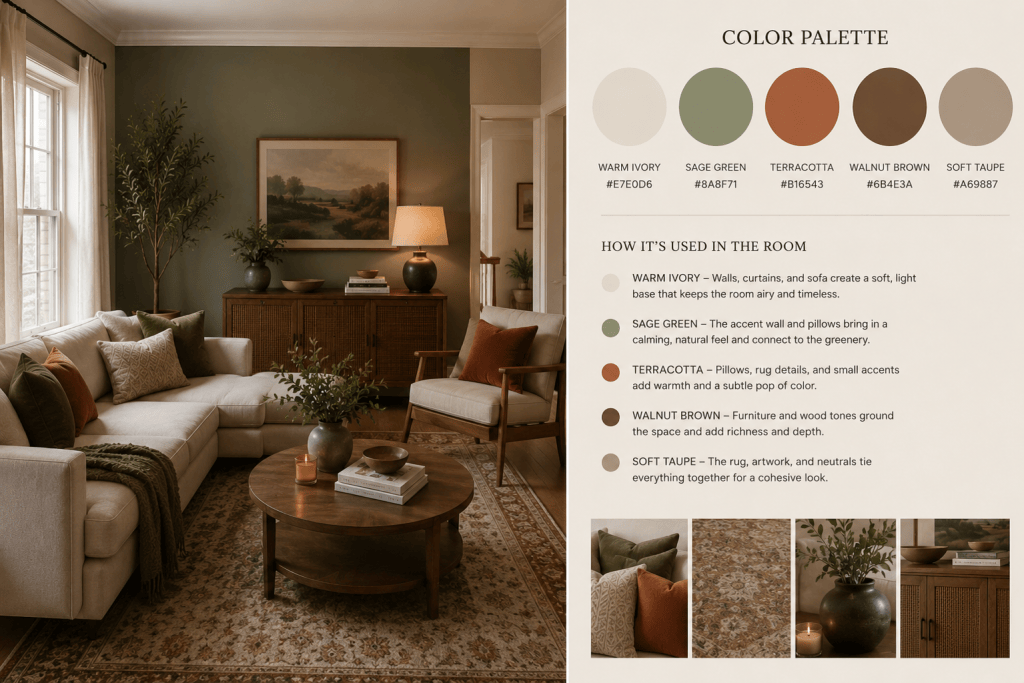
5. Create a Cohesive Color Palette
An elevated home does not have to be completely beige.
It doesn’t even have to be neutral.
Color isn’t the problem.
The problem is usually when every color in the room seems to have been chosen independently.
Instead, create a simple palette and repeat those colors throughout the space.
For example, imagine a room built around:
warm white,
olive green,
rust,
walnut wood,
and small touches of black.
The rust in a piece of artwork might appear again in a pillow.
A black picture frame might relate to a black floor lamp across the room.
The wood tone of a side table might connect visually with another piece of furniture.
These small repetitions create a sense of rhythm.
Your eye begins to understand that everything belongs to the same room—even if the individual pieces came from completely different stores.
That’s one of the easiest ways to make affordable furniture and decor feel more intentional.
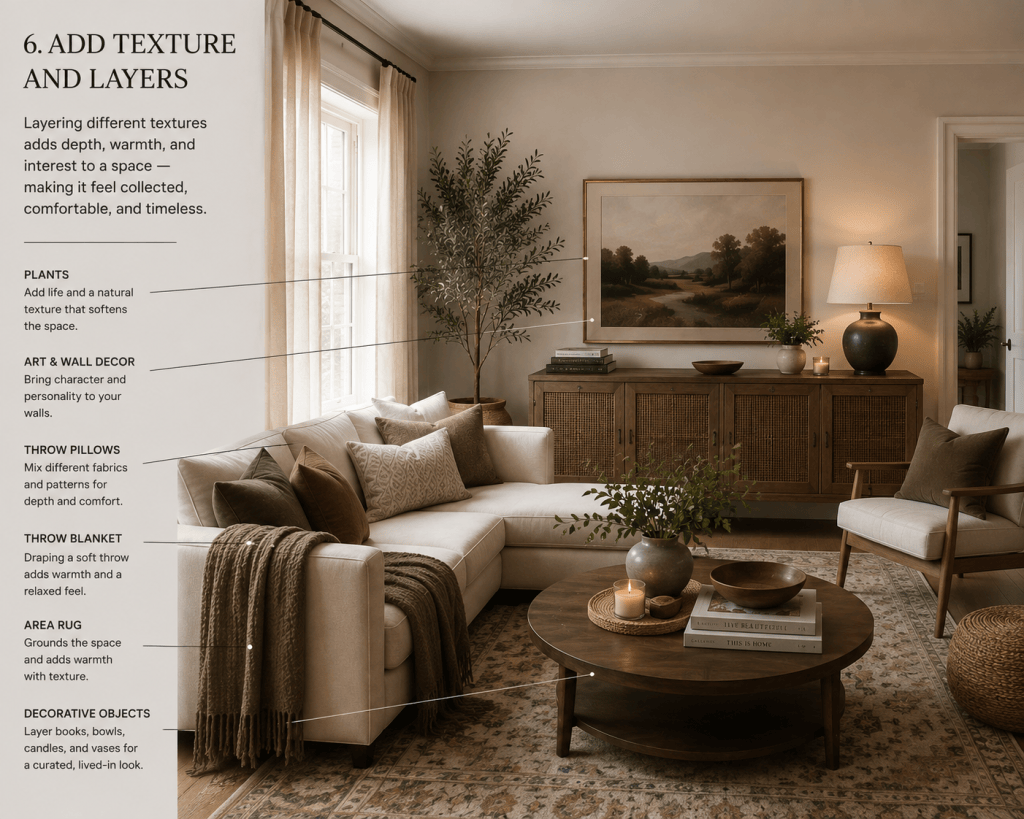
6. Mix Materials Instead of Buying Matching Sets
It can be tempting to buy an entire furniture set because everything automatically matches.
But a room where every piece is from the same collection can sometimes feel flat or overly coordinated.
Think about the difference between a room that was bought and a room that was collected.
Collected rooms usually contain some variation.
You might pair warm wood with metal.
Linen with velvet.
Glass with stone.
A smooth ceramic object with a woven basket.
A new sofa with an older side table.
These subtle differences create texture and depth.
That doesn’t mean filling the room with every material you can find. Too many competing finishes can create the opposite problem.
Instead, aim for variation within a controlled palette.
The pieces don’t have to match.
They simply need to relate.
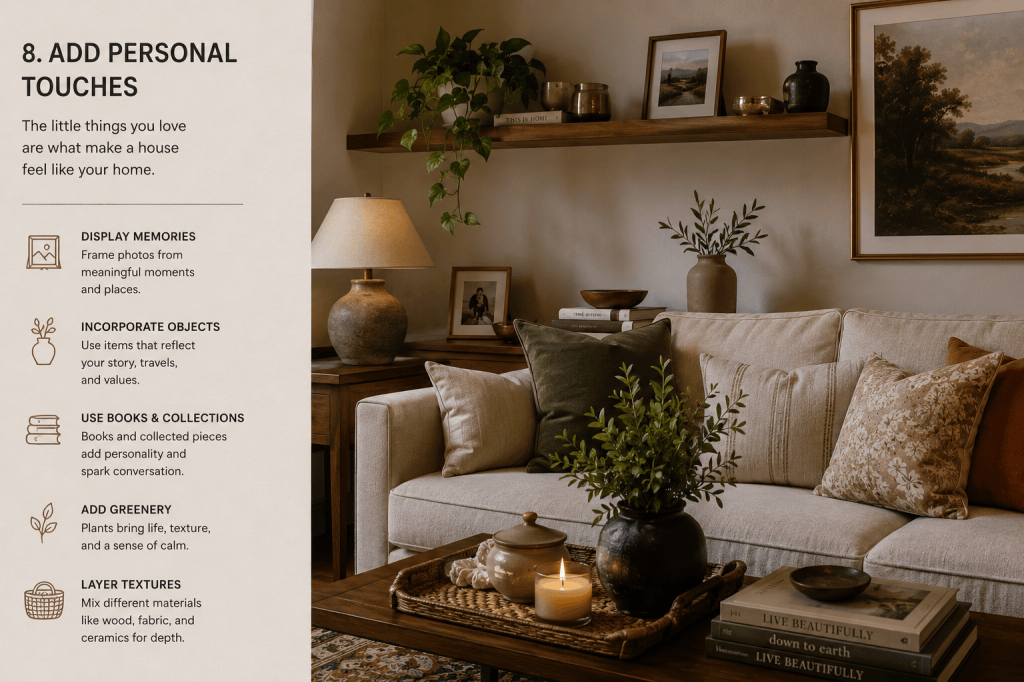
7. Choose Fewer, More Substantial Accessories
One of the quickest ways to make a room feel cluttered is filling every available surface with small decorative objects.
Try a simple experiment.
Look at your console, dresser, bookshelf, or coffee table.
If it has six or seven small objects on it, remove most of them.
Then try styling the same surface with something like:
a lamp,
a stack of books,
and one larger bowl, vase, or sculptural object.
The surface may immediately feel calmer and more sophisticated.
This doesn’t mean you can’t display meaningful collections or personal objects.
The key is giving them structure.
Group related items together instead of spreading them randomly around the room, and intentionally leave some areas empty.
Remember:
Negative space is part of the design too.
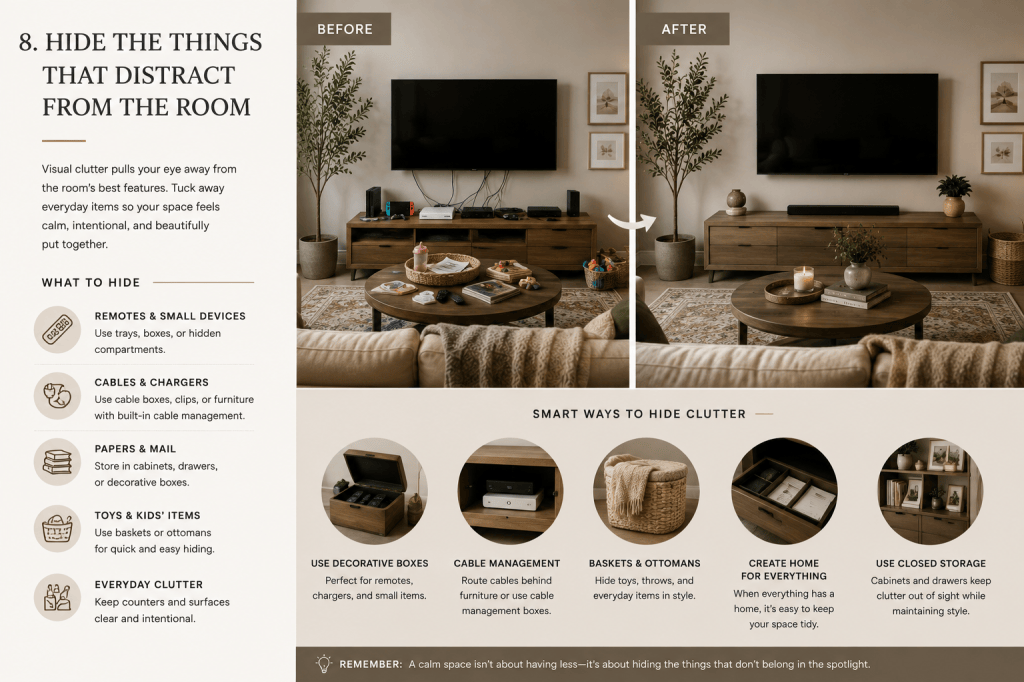
8. Hide the Things That Distract From the Room
Sometimes the biggest improvement you can make to a room has nothing to do with decorating.
Look around and notice the things your eye normally ignores.
A bundle of cords underneath the television.
Chargers beside the sofa.
Mail piling up near the entry.
Packaging sitting on the kitchen counter.
A router surrounded by wires.
Everyday clutter gathering on a dining table.
None of these things seems significant individually.
Together, however, they create visual noise.
And visual noise can make even beautiful furniture feel less polished.
Look for simple ways to conceal or organize the necessities of everyday life.
Use baskets for items you reach for frequently.
Create a designated tray for keys and mail.
Use cable management where wires are visible.
Choose closed storage for things that don’t need to be displayed.
And whenever possible, give everyday objects a consistent home.
Good design isn’t only about what you display.
It’s also about what you choose not to see.
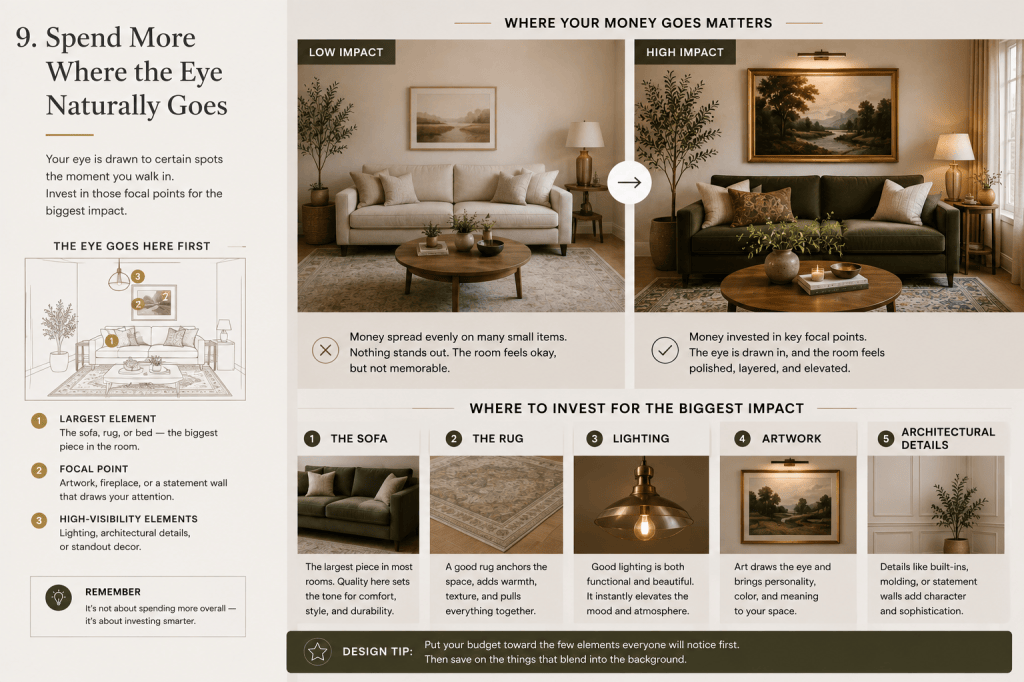
9. Spend More Where the Eye Naturally Goes
Decorating on a budget doesn’t mean choosing the cheapest option for everything.
It means deciding where your money will have the greatest visual impact.
Every room benefits from having a focal point—something that naturally attracts your attention when you enter.
Depending on the room, that might be:
- a beautiful pendant light,
- a large piece of artwork,
- an interesting vintage chair,
- a substantial rug,
- an oversized mirror,
- a distinctive coffee table,
- or an architectural feature you choose to emphasize.
Once you’ve identified that focal point, the other pieces can be quieter.
Not everything needs to compete for attention.
In fact, when everything is a statement piece, nothing really feels special.
I’d rather see a room with one memorable element surrounded by thoughtful, affordable pieces than a room filled with expensive objects that are all fighting to be noticed.
Spend strategically.
Save where the difference isn’t noticeable.
And invest where it changes how the entire room feels.
The Real Secret Isn’t Making Your Home Look Expensive
Here’s the part that matters most.
Your goal shouldn’t really be to convince someone that your home cost more than it did.
A beautiful home doesn’t need to prove how much money was spent on it.
What we’re really trying to create is a home that feels considered.
The sofa relates to the rug.
The rug works with the proportions of the room.
The curtains complement the windows.
The lighting changes the atmosphere throughout the day.
The colors repeat naturally.
There are personal objects that tell you something about the people who live there.
And there’s enough breathing room to actually notice them.
That’s what makes a space feel elevated.
Not a particular brand.
Not the latest trend.
And definitely not a room full of expensive furniture.
Before your next decor shopping trip, take a photo of the room you’re trying to improve.
Looking at a room through a photograph can make it easier to notice things you’ve stopped seeing in everyday life.
Then ask yourself:
Does this room actually need something new—or does something I already own need to be moved, removed, resized, or restyled?
Very often, that’s where the biggest transformation begins.
Before You Buy Anything: A Quick Room Check
Before adding something new to your cart, ask yourself:
Scale: Do my rug, furniture, artwork, and lighting feel appropriately sized for one another?
Lighting: Do I have more than one source of light?
Color: Are my main colors repeated throughout the room?
Curtains: Are they positioned to complement the window and the height of the room?
Clutter: Is there anything visible that I could simplify, organize, or conceal?
Focal point: Where does my eye naturally go when I enter the room?
Personality: Does this room actually tell me something about the people who live here?
If something feels wrong, don’t immediately assume the solution is another purchase.
Sometimes moving a lamp, removing three accessories, raising a curtain rod, or choosing the right-size rug can do more for a room than buying something new ever could.
Thoughtful design isn’t about having more. It’s about making better decisions with what you have.
 Kareman Interiors
Leave a comment