Modern interiors are often described with the same familiar words: clean, simple, uncluttered, neutral.
And yet, those qualities can sometimes create the exact problem homeowners are trying to avoid—a room that looks beautiful in a photograph but feels cold, sparse, or strangely impersonal in real life.
The solution isn’t to abandon modern design or fill the room with more things. A warm modern interior still has restraint. It still values clean lines, function, open space, and thoughtful simplicity. The difference is that it balances those qualities with texture, natural materials, softer forms, layered lighting, and pieces that give the room a sense of life.
The goal isn’t simply to make a modern room look warmer.
It’s to make it feel like someone belongs there.
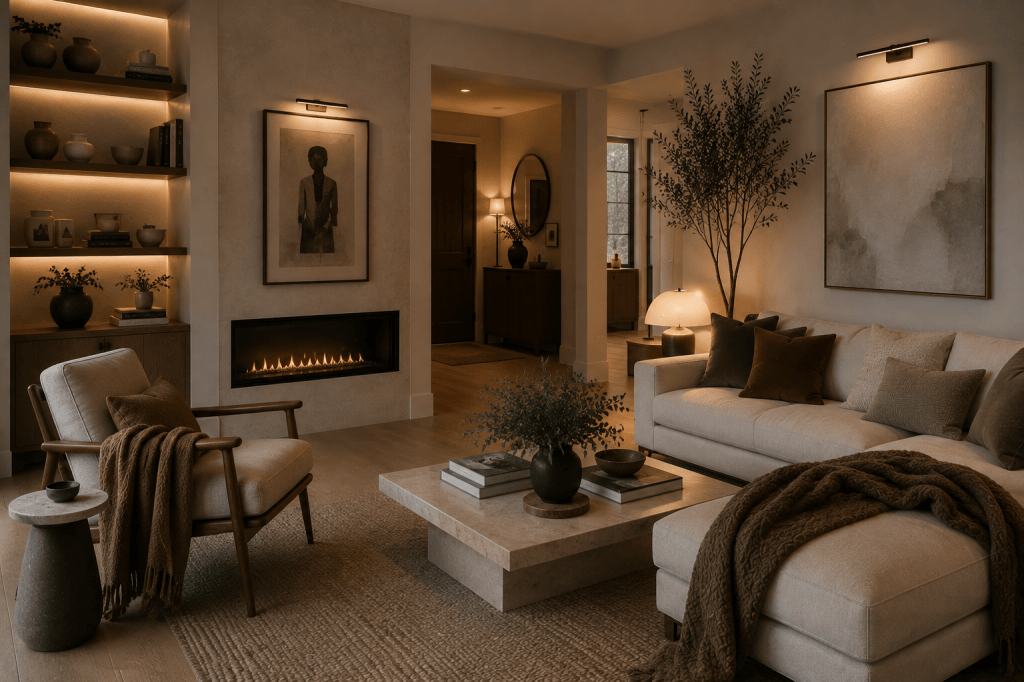
What Is Modern Interior Design?
Before decorating a modern space, it helps to understand what “modern” actually means.
Modern interior design is rooted in the modernist design movement of the early-to-mid 20th century. It moved away from heavy ornamentation and embraced function, simplicity, clean forms, honest materials, and the idea that every element should have a purpose.
In interiors, that often translates to:
- Clean architectural lines
- Simple furniture silhouettes
- Functional layouts
- Limited ornamentation
- Natural materials such as wood, leather, stone, and metal
- A controlled color palette
- An emphasis on form and proportion rather than decoration
But modern does not have to mean stark white walls, gray furniture, sharp corners, and an almost-empty room.
Some of the most successful modern interiors are actually incredibly warm. Their simplicity allows beautiful materials, thoughtful proportions, craftsmanship, art, and everyday objects to stand out.
That distinction matters.
Simplicity should create clarity—not emptiness.
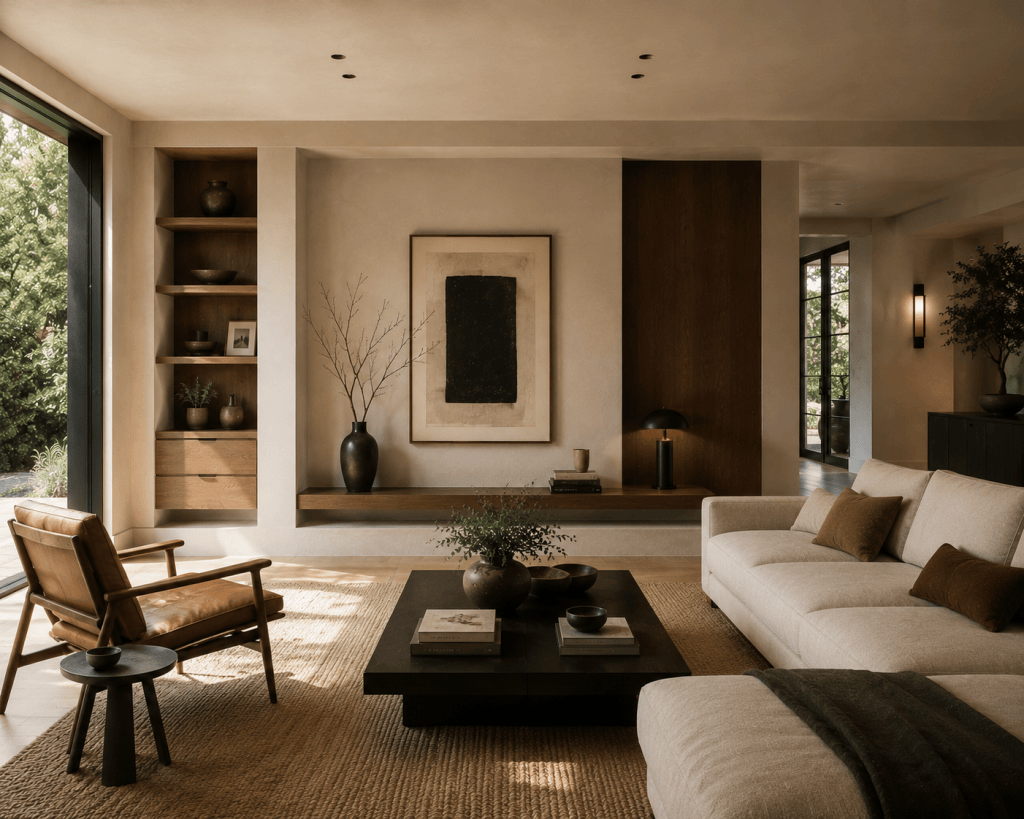
Why Can Modern Interiors Feel Cold?
Usually, the problem isn’t modern design itself. It’s what happens when its principles are taken too literally.
Remove too many objects and the room loses personality.
Use only smooth surfaces and the room loses tactile interest.
Choose one neutral color for everything and the space loses depth.
Use only recessed ceiling lights and the atmosphere becomes flat.
Buy every piece from the same furniture collection and the room begins to feel like a showroom.
Warmth comes from contrast and layering.
Smooth needs something textured. Straight lines benefit from something curved. New pieces feel richer beside something aged or handmade. A neutral palette becomes more interesting when its tones and materials vary.
Instead of asking, “What can I add to make this room cozy?” start by asking:
What is this room missing—texture, contrast, softness, light, character, or life?
That question usually leads to a much better solution.
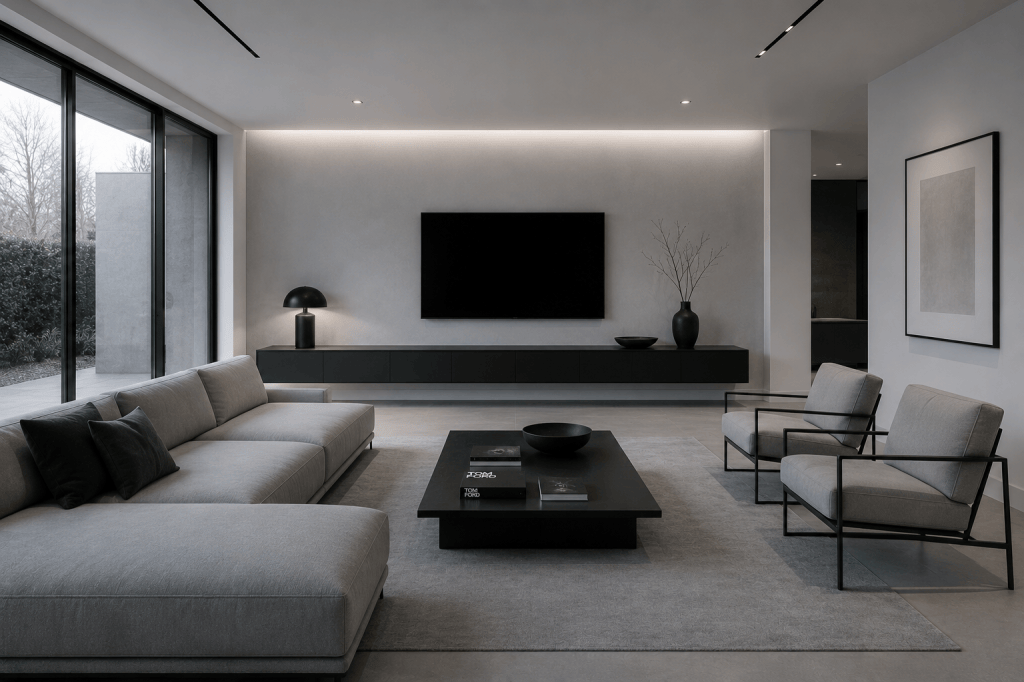
1. Warm Up the Materials
If you want a modern room to feel warm, start with the materials before you start buying decorative accessories.
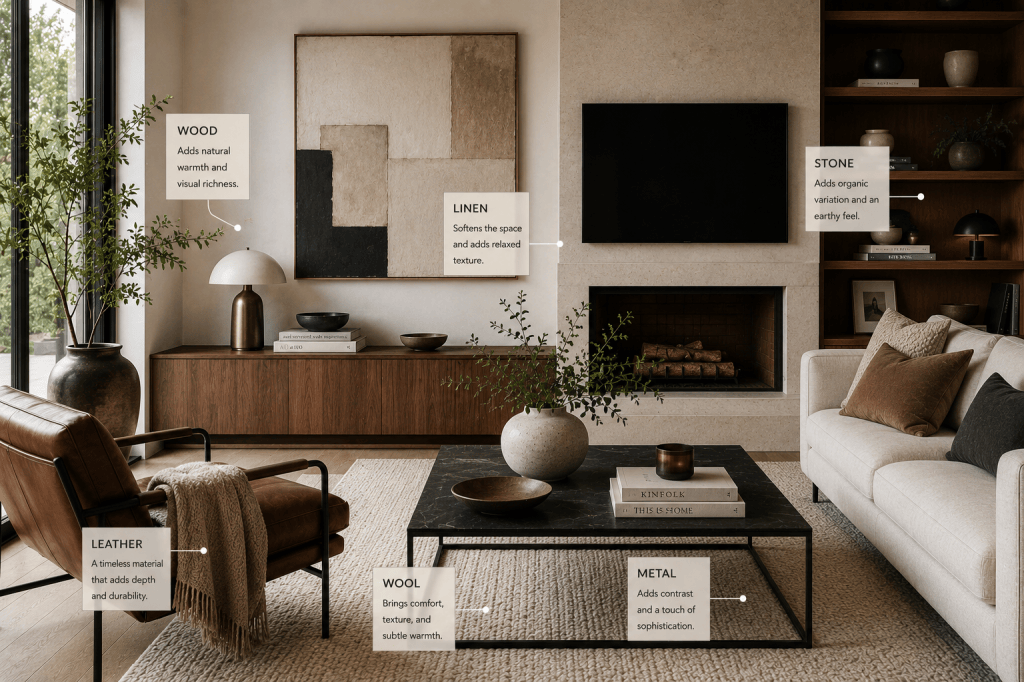
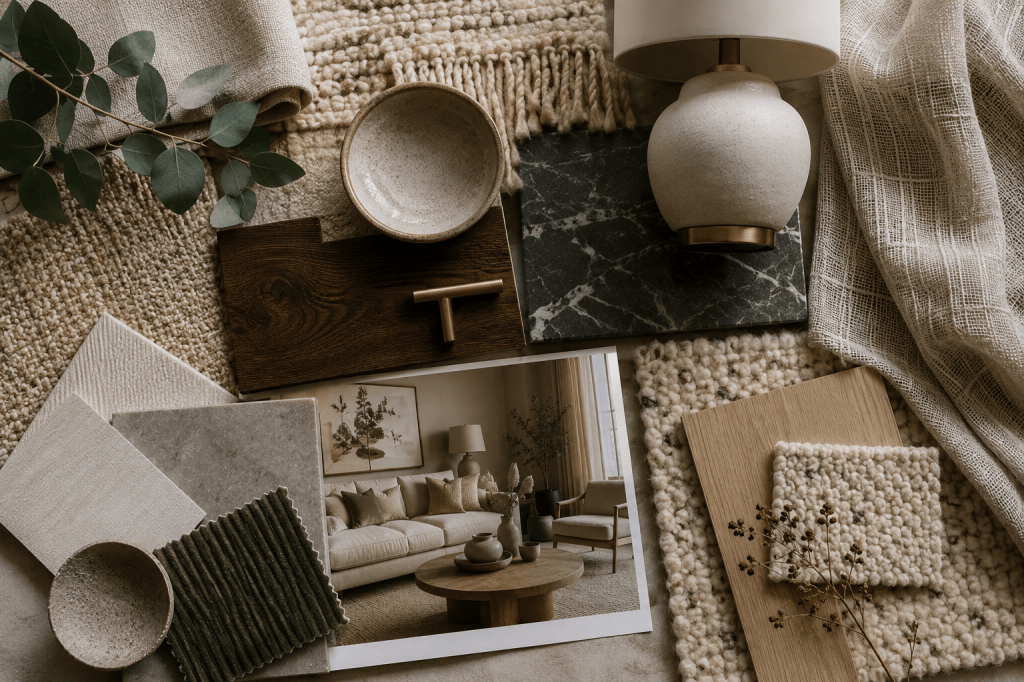
Natural materials bring variation that perfectly manufactured surfaces often lack. Wood has grain. Linen has movement. Stone has irregularity. Wool has texture. Handmade ceramics are never completely identical.
Those subtle imperfections make a room feel more human.
Consider mixing materials such as:
- Warm-toned wood
- Linen
- Wool
- Cotton
- Leather
- Travertine or other natural stone
- Plaster
- Woven fibers
- Handmade ceramics
- Brushed or aged metals
You don’t need all of them.
In fact, using too many materials can make a modern room feel visually busy. Instead, choose a few and repeat them throughout the space.
For example, a walnut coffee table might relate to a wooden picture frame across the room. A linen sofa can connect visually with linen curtains. A stone side table can echo the texture of a ceramic lamp.
That repetition creates cohesion without requiring everything to match.
2. Choose Neutrals With Depth
A warm modern palette does not automatically mean beige.
This is one of the easiest ways to accidentally make a room feel generic.
Instead of thinking about one “neutral color,” think about layers of related neutrals with different undertones and values.
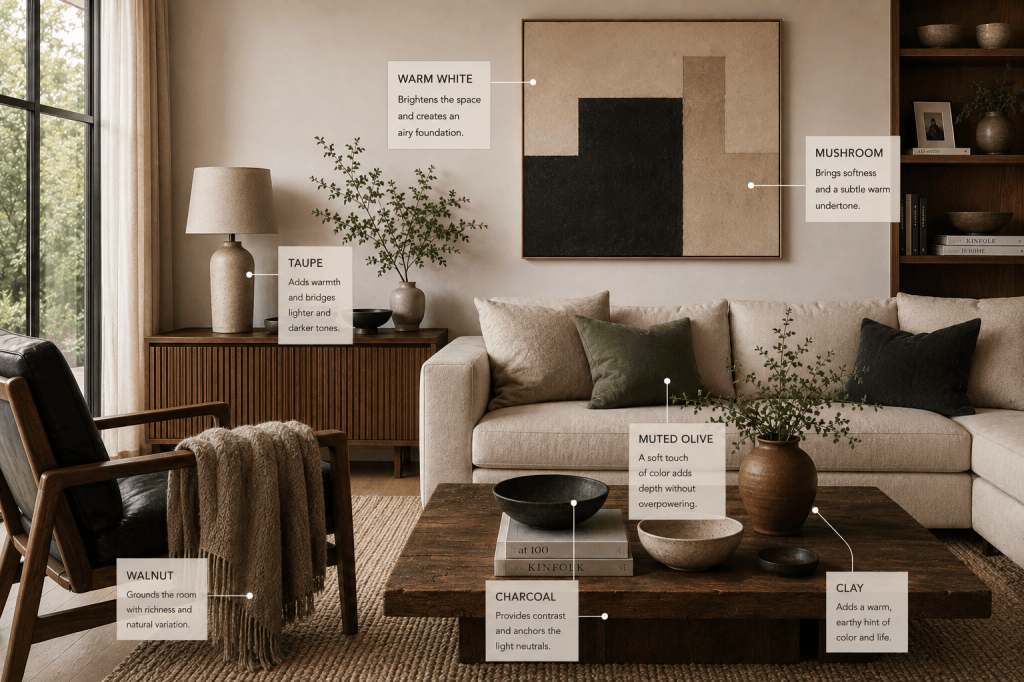
Warm white can sit beside mushroom, taupe, camel, soft brown, muted olive, charcoal, clay, or dusty terracotta. Even cooler colors can work beautifully when they are balanced with warmer materials.
The important thing is variation.
If the walls, sofa, rug, curtains, and cushions are almost exactly the same shade of beige, the room can feel flat even if every individual item is beautiful.
A stronger approach might be:
warm white walls + oatmeal upholstery + walnut wood + muted olive + black or aged-brass accents.
The palette is still restrained, but now the eye has somewhere to travel.
And don’t underestimate darker colors.
A little black, deep brown, charcoal, burgundy, or forest green can give a pale modern room the visual weight it needs.
Warmth is not just about making everything lighter. Sometimes contrast is what makes the softer elements feel soft.
3. Layer Texture Before Adding More Decor
When a room feels unfinished, the instinct is often to buy more objects.
Try texture first.
A modern room with a sofa, coffee table, rug, and two chairs may already contain enough furniture. What it might be missing is variation in how those surfaces look and feel.
Imagine the difference between:
a smooth sofa + smooth table + smooth floor + smooth walls
and:
a linen sofa + wool rug + grained wood + softly woven curtains + ceramic lamp.
The number of objects barely changed.
The experience of the room did.
This is why texture is especially powerful in neutral interiors. When color is restrained, texture creates the visual depth that stronger color might otherwise provide.
Look at the room as a collection of surfaces.
If everything is hard, introduce softness.
If everything is smooth, add something tactile.
If everything is matte, perhaps one subtle reflective material would create contrast.
You’re not trying to collect textures. You’re creating relationships between them.
4. Balance Clean Lines With Softer Shapes
Modern design loves geometry.
That’s part of what makes it feel orderly and calm—but too many rectangles can make a room feel rigid.
Look around a typical room: the walls are rectangular. The windows are rectangular. The rug may be rectangular. The sofa, console, television, artwork, and coffee table may all repeat the same geometry.
Something needs to interrupt that rhythm.
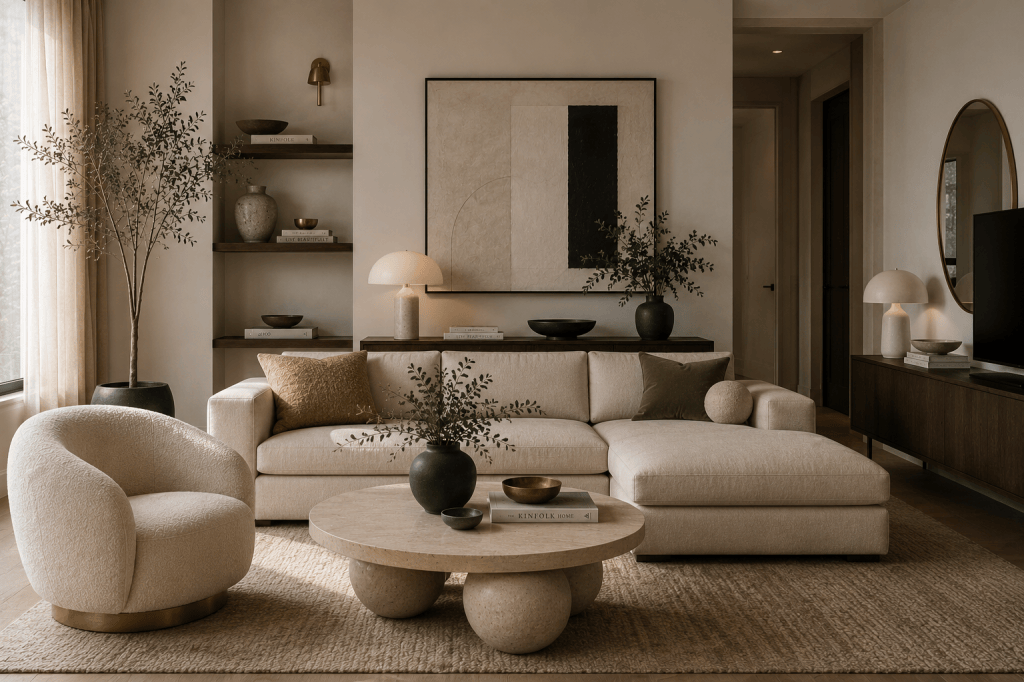
It might be:
- A rounded coffee table
- A curved lounge chair
- A sculptural lamp
- An irregular ceramic vessel
- A round mirror
- A softly shaped sofa
- An organic side table
You don’t need to replace every straight line with a curve.
One or two softer forms can be enough to change the character of the entire composition.
This is one of those small design decisions that often makes a room feel more comfortable without anyone immediately knowing why.
5. Use Layered Lighting Instead of One Bright Source
Lighting can completely change how a modern interior feels.
A beautifully furnished room under one harsh ceiling light can still feel clinical.
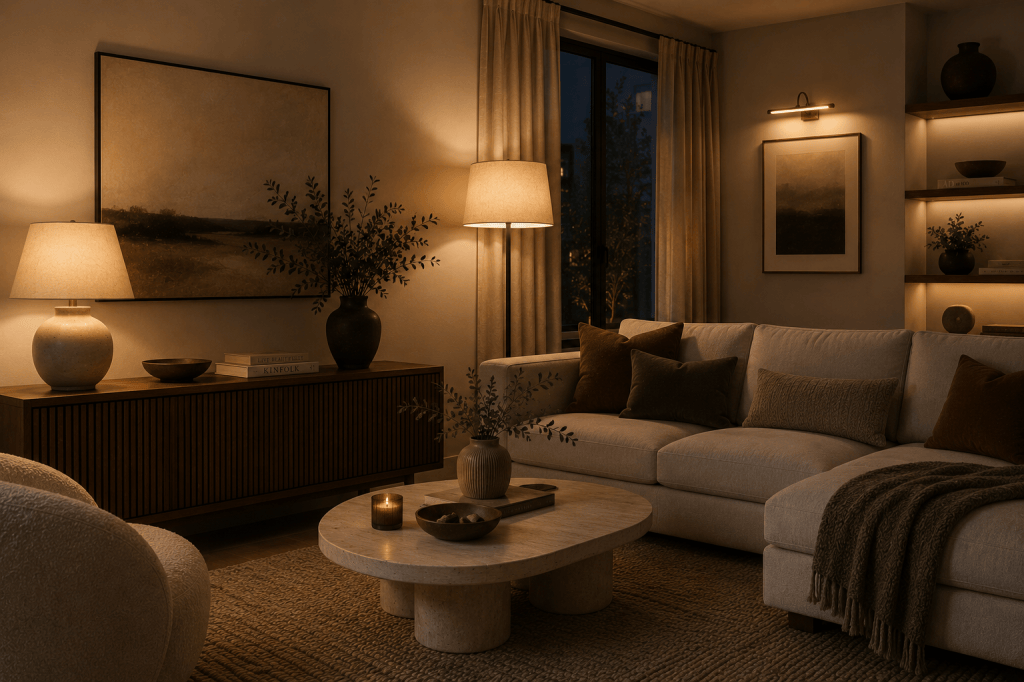
Instead, think about lighting in layers.
A well-balanced room usually combines:
Ambient lighting for overall illumination.
Task lighting where you actually need to see clearly, such as beside a reading chair, desk, or kitchen counter.
Accent lighting to create atmosphere or highlight artwork, architecture, or a particular corner.
In a living room, for example, that might mean a ceiling fixture combined with a floor lamp near the sofa and a small table lamp on a console.
At night, you may barely need the overhead fixture at all.
Also pay attention to the light itself. In residential spaces intended for relaxation, warmer light generally creates a more comfortable atmosphere than very cool, blue-white illumination.
The fixture matters, but the quality and placement of the light matter more.
6. Add Personality Without Adding Clutter
This is where minimal interiors sometimes go wrong.
In an effort to keep the room clean, everything personal disappears.
The shelves become a collection of anonymous decorative objects. The artwork is chosen because it matches the sofa. Every surface is perfectly styled.
The room may look finished—but it doesn’t tell you anything about the person who lives there.
Instead of filling the space with decor, choose fewer things with more meaning.
That could be:
- Art you genuinely love
- Books you actually read
- A vintage piece
- Something brought home from a trip
- A handmade object
- Family photography displayed thoughtfully
- An inherited piece
- A ceramic object from a local maker
Not everything needs a story, of course. Sometimes a beautiful lamp is simply a beautiful lamp.
But when nothing in a room has personal significance, the result can start to feel manufactured.
A modern home doesn’t need more stuff.
It needs enough evidence of the people living in it.
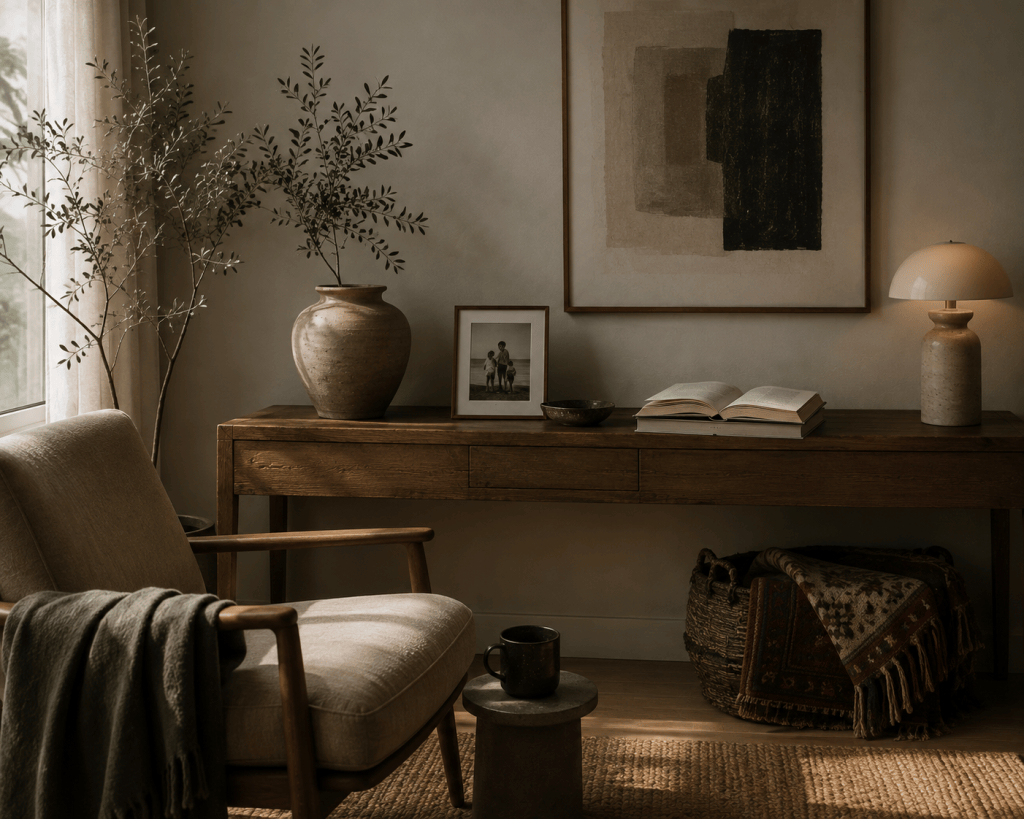
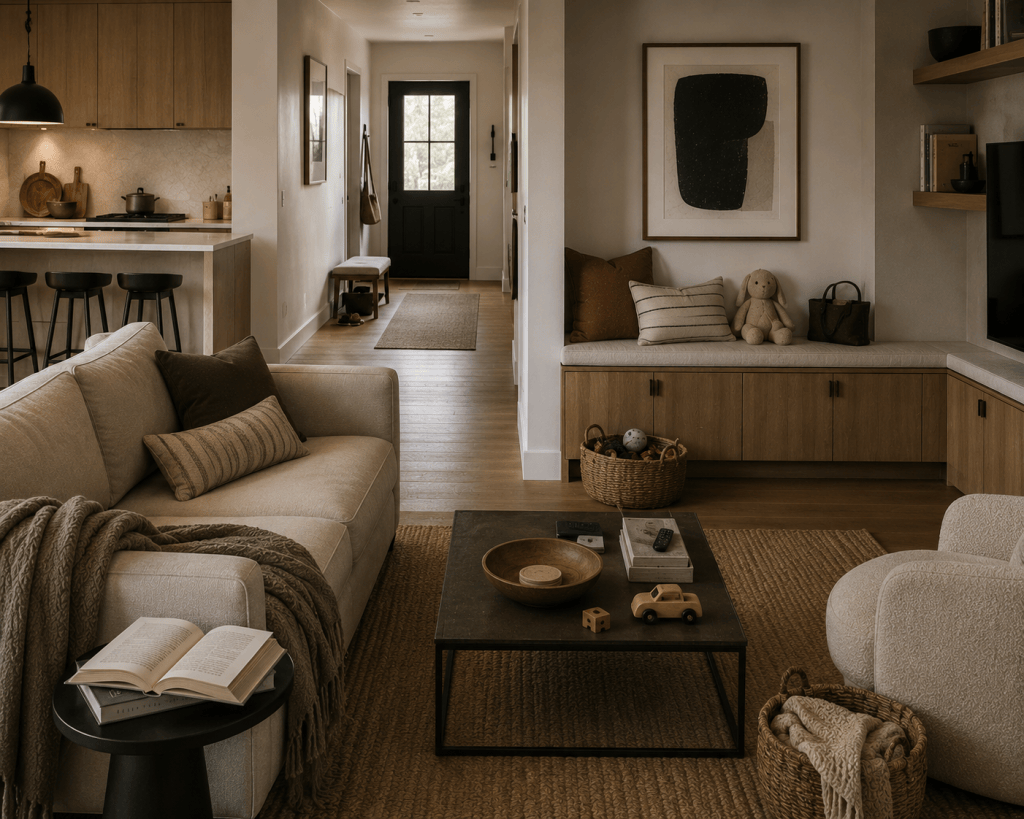
7. Let the Room Feel Lived In
There is a difference between an intentional room and a perfect room.
Real homes change throughout the day. A book gets left beside a chair. Curtains move. A blanket is used. A child’s object occasionally appears where it wasn’t supposed to. A plant grows slightly unevenly.
That doesn’t mean abandoning good design.
It means designing a room that can tolerate real life.
Choose furniture because it works for the way you live—not only because it creates the perfect photograph.
Leave enough circulation space.
Give everyday objects somewhere convenient to go.
Use materials appropriate for the amount of wear they will receive.
Provide storage where clutter naturally accumulates rather than where storage happens to look symmetrical.
A room becomes much easier to maintain when the design works with your habits instead of against them.
That is when modern simplicity becomes genuinely livable.
Modern vs. Contemporary Interior Design: What’s the Difference?
The terms modern and contemporary are often used interchangeably, but they don’t mean exactly the same thing.
Modern design refers broadly to a historical design movement associated with the first half and middle of the 20th century. Its principles include simplicity, functionalism, clean forms, and reduced ornamentation.
Contemporary design, on the other hand, describes design happening in the present.
That means contemporary interiors continuously change as materials, lifestyles, technologies, and aesthetic preferences evolve.
The two can certainly overlap. A contemporary home might borrow heavily from modernist principles, which is one reason the distinction can feel blurry.
For your own home, you don’t need to become overly concerned with labels.
Understanding a style is useful because it gives you a framework.
But your home becomes interesting when you know which rules to keep, which ones to soften, and where your own personality belongs.
The Warm-Modern Formula to Remember
If all of this feels like a lot to consider, simplify it.
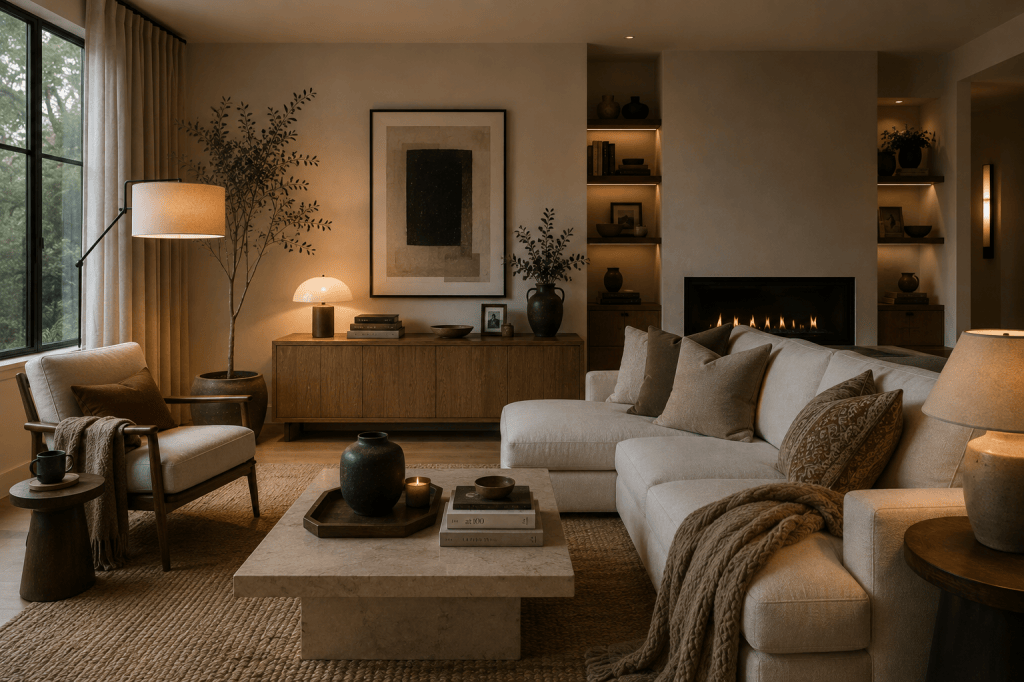
A warm modern room can often be built around five ideas:
Clean foundation + natural materials + tactile texture + layered lighting + personal character.
Start with the architecture and major furniture.
Then ask:
Does the room have enough material variation?
Does it have both hard and soft surfaces?
Is there contrast in the palette?
Are there multiple sources of light?
Is there at least one element that feels personal rather than purchased simply to complete the room?
You may discover that the room doesn’t need another piece of furniture at all.
It may just need another layer.
Frequently Asked Questions
Can modern interior design still feel cozy?
Absolutely. Modern design and coziness are not opposites. Keep the clean lines and functional simplicity of modern design, but introduce warmth through natural materials, textiles, comfortable furniture, layered lighting, and personal objects.
What colors make a modern home feel warmer?
Warm whites, taupes, mushroom tones, camel, soft browns, muted greens, clay tones, and other earthy colors work particularly well. However, you don’t need an entirely warm palette. Cooler colors can also feel inviting when balanced with wood, textiles, warm lighting, and other natural materials.
What materials work well in warm modern interiors?
Wood, wool, linen, cotton, leather, natural stone, plaster, woven fibers, and ceramics are all useful. The goal isn’t to use every natural material available, but to combine a small selection with enough variation to create depth.
How do I make a modern living room feel less sterile?
Before buying more decor, check the room for texture, lighting, material variety, softness, contrast, and personal elements. A rug with visible texture, curtains, a warm wood element, a curved furniture piece, a lamp, or meaningful artwork may do more than several new decorative accessories.
Is modern interior design the same as minimalism?
No. They share some characteristics, including simplicity and reduced visual clutter, but they are not the same design style. A modern interior can contain color, art, texture, books, collections, and decorative objects while still maintaining a clear and intentional composition.
A Modern Home Should Still Feel Like Home
The best modern interiors aren’t memorable because they are perfectly minimal.
They’re memorable because restraint gives the right things room to matter.
A beautiful grain of wood becomes more noticeable. A sculptural chair has space around it. Artwork becomes meaningful rather than decorative filler. Soft light changes the mood of a simple wall.
So if your modern room feels cold, don’t immediately fill it.
Look at what is already there.
You may not need more furniture, more decor, or another trend.
You may simply need more warmth, more contrast, and a little more of yourself.
 Kareman Interiors
Leave a comment